Case Study
Wow Chat – Real-Time Communication Platform
A production-ready backend for a multi-device, wallet-authenticated messaging and calling platform, designed to handle thousands of concurrent connections with a scalable, cluster-based architecture.
Websites contributed to (public + safe to share)
- WOW Web Chat (wowchat.online): Built and scaled the real-time platform foundations (auth, messaging sync, calling signaling, observability, deployments). Outcome: a production-ready system designed to handle thousands of concurrent WebSocket connections with low-latency delivery.
Project Overview
Wow Chat is a real-time communication platform that supports one-on-one chats, group chats, broadcast channels, and video/audio calling. The backend is built with TypeScript, Node.js, Express.js, Socket.io, MongoDB, and Redis, with a strong focus on scalability, security, and multi-device synchronization.
Role & Scope
- Backend Developer & System Architect
- End-to-end design of real-time architecture
- Implementation of authentication, messaging, and calling flows
Tech Stack
- TypeScript, Node.js, Express.js
- Socket.io, WebRTC (signaling)
- MongoDB, Redis
- AWS S3, Docker, PM2, GitHub Actions
Frontend (FE) considerations
- Real-time UX readiness: Designed event payloads and state transitions to support responsive UI patterns like optimistic message sending, presence, typing indicators, and read receipts without excessive re-fetching.
- Multi-device consistency: Ensured deterministic message ordering and idempotent delivery semantics so frontend clients can reconcile state cleanly across devices/sessions.
- Performance & reliability: Emphasized low-latency socket events, backpressure-friendly flows, and clear error envelopes to keep UI behavior predictable under load.
Key Challenges Solved
- Real-time multi-device sync: Messages and calls stay in sync across all user devices using user-specific Socket.io rooms and robust session management.
- Scalability: Cluster-based Socket.io architecture with Redis pub/sub and sticky sessions to handle thousands of concurrent WebSocket connections.
- Wallet-based authentication: Secure Web3 login with JWTs, Redis-backed sessions, device management, and QR-based web login flows.
- Reliable media & notifications: AWS S3 for media storage and OneSignal for push/VoIP notifications to keep users connected across platforms.
Feature Highlights
Messaging
- One-on-one and group chats with roles (admin/moderator)
- Broadcast channels for large audiences
- Typing indicators, read receipts, online presence
- Support for text, images, videos, and documents
Calling & Security
- WebRTC-based audio/video call signaling with logs
- Wallet auth + Google OAuth + QR login for web
- JWT-based auth, secure cookies, session revocation
- Abuse protection with blocking/reporting flows
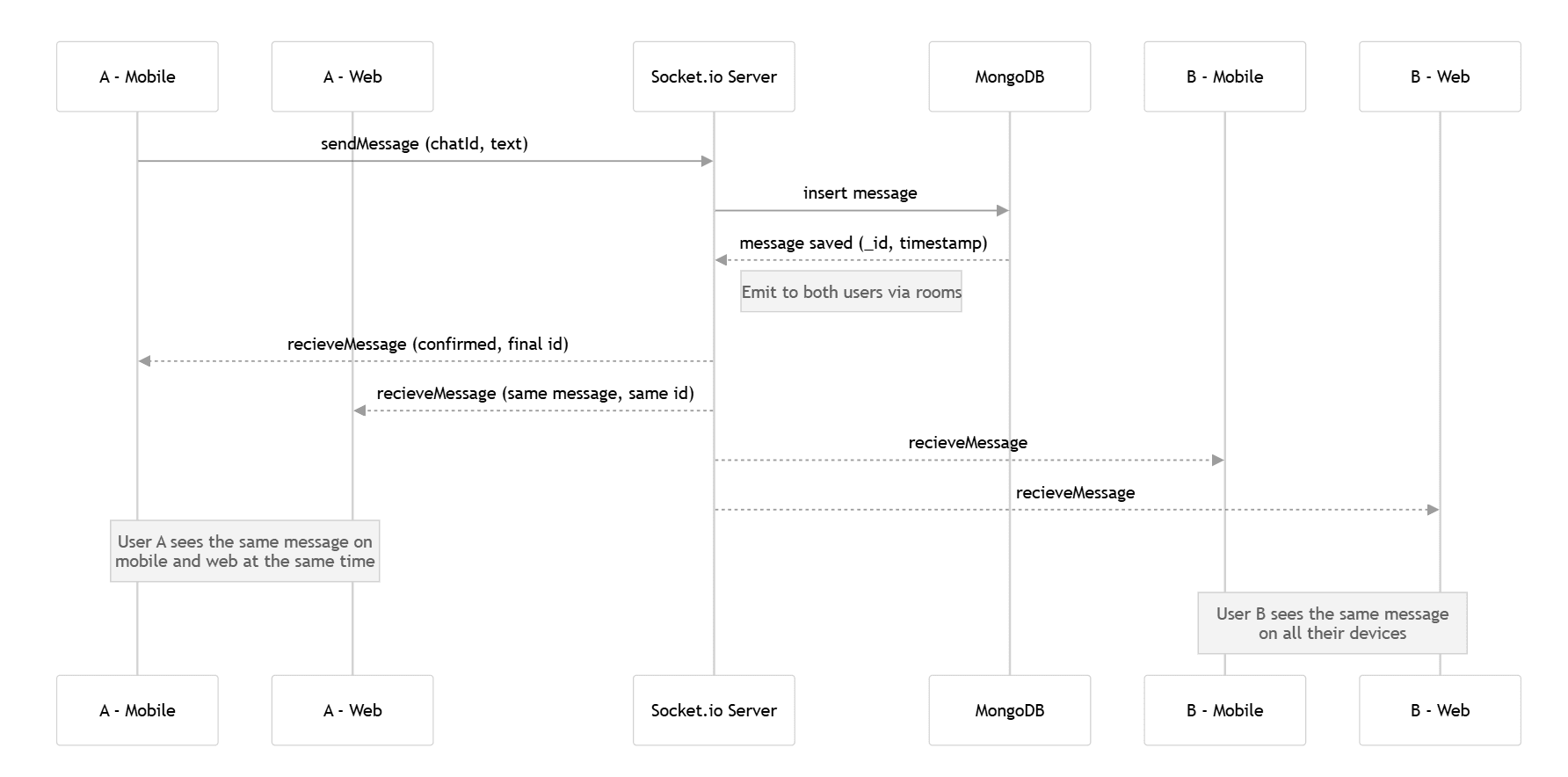
Multi-device Messaging Flow
The sequence diagram below shows how a single message is delivered and synchronized across all of a user's devices using Socket.io rooms and MongoDB as the source of truth.
Results
- Supports thousands of concurrent WebSocket connections with low latency messaging.
- Zero-downtime deployments and horizontal scaling using Docker + PM2 + Redis.
- Robust monitoring, logging, and error handling for production reliability.
- Provides a solid foundation for future features like E2E encryption, analytics, and more.